Organisation guide
A Kit You Can Actually Navigate
A good kit is not the largest one; it is the one where your hand finds the right object without looking. Order makes routines faster, reduces duplicate purchases and makes care easier to keep up.
Start with an honest inventory
Empty everything onto a clean towel: makeup, brushes, pouches, jewellery, hair accessories, small mirrors. Do it all at once, because separate drawers hide duplication. Then sort by a single question — when did I last use this? — rather than by category. You will usually find three groups: things used in the last fortnight, things used for specific occasions, and things that have not been touched in months.
The last group is not automatically for disposal. Some items are unopened backups; some are sentimental; some have simply been forgotten. But it should not live in the same space as what you use every morning. Mixing tiers is the main reason kits feel unmanageable.
Kit inventory
Three tiers, three places
| Tier | Typical contents | Where it lives | Review |
|---|---|---|---|
| Daily core | Base, one cheek, brow, mascara, two lips, two brushes, everyday earrings | Top tray or one zipped pouch | Every week |
| Occasion tray | Evening lip, shimmer, statement jewellery, silk scarf | Lidded box, second drawer | Monthly |
| Reserve shelf | Unopened backups, seasonal shades, rarely worn pieces | Closed cupboard, labelled | Quarterly |
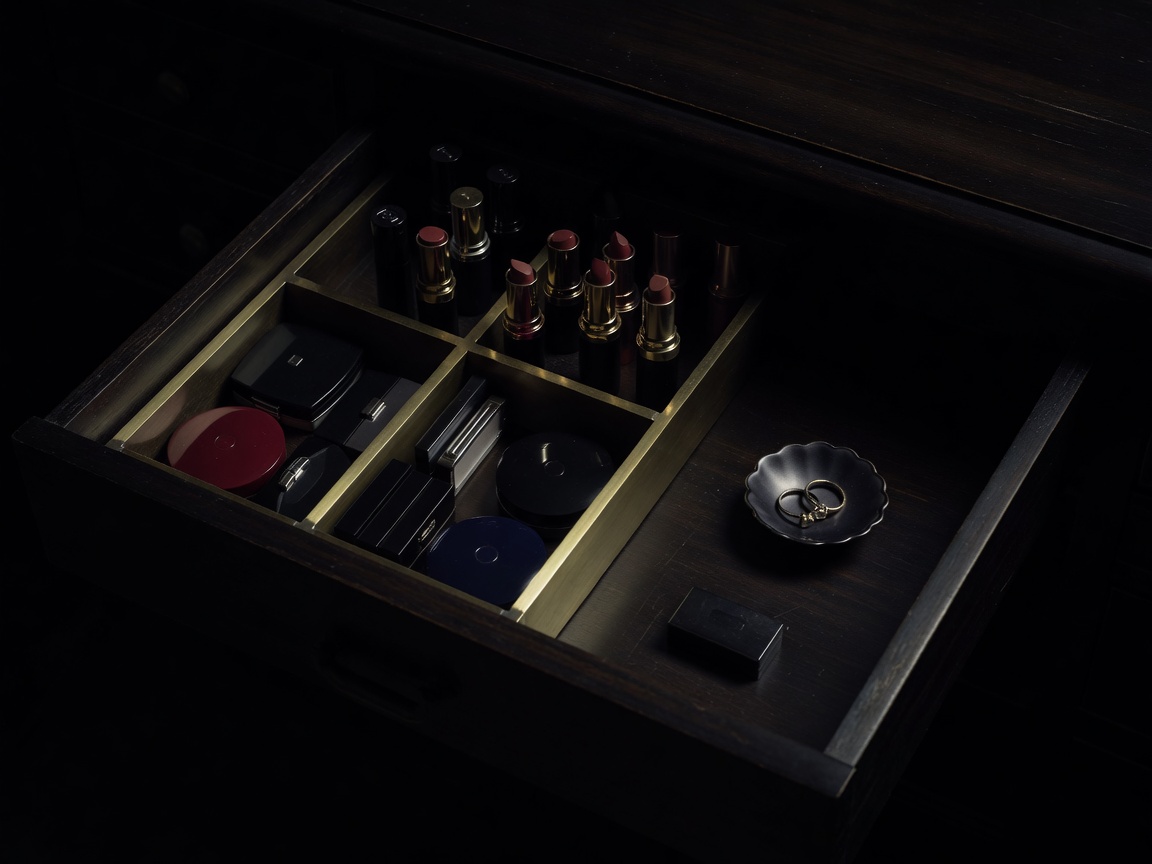
Zoning a pouch so it stays zoned
A single open pouch becomes a lucky dip within days. Zoning does not require special organisers; it requires a rule about where things go. A workable pattern is to keep flat items (compacts, palettes) against the back wall, upright items (pencils, mascara, lipsticks) along the front, and brushes in their own sleeve or a rolled cloth so their heads stay clean and shaped. Jewellery should never travel loose beside makeup: powder settles in clasps and settings, and metal edges can scratch compact mirrors. A small fabric jewellery roll or a hard pill-style case separates the two worlds.
Label opening dates
Many products carry a period-after-opening symbol — an open jar with a number and the letter M, such as 6M or 12M. It indicates how many months the product is intended to be used after opening. A small strip of masking tape with the month you opened it, written on the base, turns that symbol into something you can actually act on. When you review the daily core each week, a glance at the base tells you whether the item is still within its intended period.
Keep accessories visible, not buried
Unlike makeup, accessories often go unworn simply because they are out of sight. A shallow tray with dividers, a few hooks for chains so they do not tangle, and scarves folded in a single row rather than a stack make your options visible. Visibility is also a useful brake on buying: if you can see four pairs of gold hoops at once, it becomes obvious that a fifth is unlikely to change much.
Travel kit
Packing for a flight
Liquids
Many UK and EU airports apply 100 ml containers in a one-litre clear bag; the US TSA uses the 3-1-1 rule (3.4 oz). Some airports with newer scanners have relaxed this — always check your departure airport.
Solids first
Stick foundations, balm blush and solid cleansers avoid liquid limits entirely.
Weekly reset
A ten-minute close
Return every daily-core item to its zone.
Check opening labels and wipe compact mirrors.
Move anything unused for two weeks to the occasion tray.
Collect brushes for washing day.
When to stop adding
A kit has reached a useful size when every daily-core item gets used and nothing in the tray is a near-duplicate of something else. If you notice that you are browsing to replace a product that is still half full, pause and check whether the new one would actually take a different role. Often the answer is that the old one would do the same job with a slightly different technique — a thinner layer, a different brush, a change of light. The register's position is simple: refinement usually comes from using things better, not from owning more of them.
A kit that is easy to navigate is also easy to care for, which is the subject of Care Across Brushes, Metal and Fabric.